
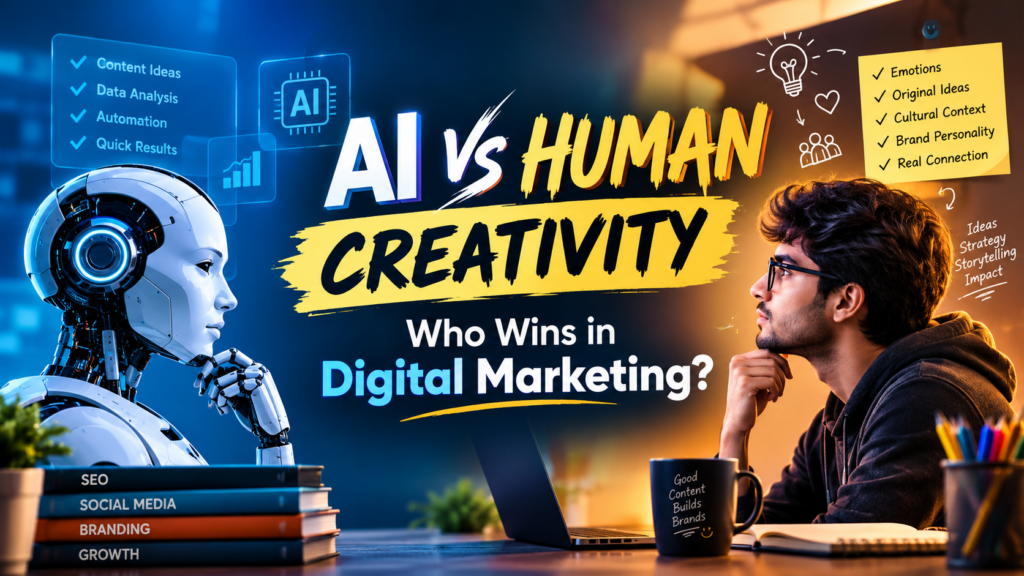
AI vs Human Creativity: Who Wins in Digital Marketing?
Introduction Artificial Intelligence (AI) is changing the way businesses promote their products and services online. From generating social media posts and writing blogs to creating advertisements and analyzing customer behavior, AI tools are making digital marketing faster and more efficient than ever before. But this raises an important question: Can AI replace human creativity in digital marketing, or is human imagination still irreplaceable? The truth is that AI and human creativity have different strengths. While AI can process information, identify patterns, and generate content quickly, humans bring emotions, originality, cultural understanding, and strategic thinking to the table. In 2026, successful digital marketing depends on understanding how to combine these strengths. 1. What AI Brings to Digital Marketing AI has become a valuable assistant for digital marketers. It helps reduce repetitive work, speed up content production, and make decisions using data. Here are some major ways AI is transforming marketing: For example, a digital marketer managing an Instagram account can use AI to brainstorm 30 post ideas, create caption drafts, and organize a monthly content calendar. This saves time and allows the marketer to focus on improving the overall strategy. However, AI-generated content is not automatically accurate, original, or effective. Human review remains essential. 2. Why Human Creativity Still Matters Digital marketing is not just about producing content. It is about understanding people, earning their trust, and encouraging them to take action. Human creativity brings several qualities that AI cannot reliably reproduce on its own. Emotional understanding: Humans can draw on personal experiences and understand the emotional context behind customer decisions. An advertisement that makes people feel understood can be more memorable than one that simply lists product features. Original ideas: AI often generates content based on patterns learned from existing material. Humans can challenge conventional thinking, connect unexpected ideas, and create distinctive brand experiences. Cultural awareness: Humor, language, traditions, and social trends differ across audiences. Human marketers can interpret these nuances and recognize when a campaign might be misunderstood or considered insensitive. Brand personality: Every brand needs a recognizable voice. Human creativity helps businesses communicate in ways that reflect their values, identity, and relationship with customers. Consider a local business in Mumbai launching a festive campaign. AI might suggest attractive captions and promotional offers, but a marketer who understands local humor, customer preferences, and cultural context can turn those suggestions into a campaign that feels authentic and relatable. That human touch can make the difference between content that simply gets published and content that genuinely connects with people. 3. AI vs Human Creativity: A Quick Comparison Area AI Human creativity Speed Generates drafts quickly Needs time to develop ideas Data analysis Processes large datasets efficiently Interprets insights within a broader context Emotional connection Can imitate emotional language Draws on lived experience and empathy Originality Often builds on learned patterns Can challenge conventions and create new concepts Consistency Helps maintain repeatable workflows Adds judgment and distinctive personality Decision-making Supports data-driven recommendations Balances context, ethics, and business goals Neither approach is perfect. AI can make mistakes or produce generic content, while humans can overlook data, make assumptions, or struggle with limited time and resources. Combining both can help overcome these limitations. 4. How Digital Marketers Can Combine AI and Human Creativity Instead of treating AI as a competitor, marketers should learn to use it as a creative partner. Here are five practical ways to do this: 1. Use AI for brainstorming. Generate multiple campaign concepts, headlines, and content angles. Then select and refine the strongest ideas based on the brand’s audience and goals. 2. Add real human experiences. Include customer stories, personal observations, genuine testimonials, and real-world examples. These details make content more specific and trustworthy. 3. Use AI for research and analysis. Let AI help organize information and identify patterns, but verify important facts and make the final decisions yourself. 4. Experiment with creative variations. Use AI to develop alternative ad headlines, images, or captions. Test them with real audiences and use performance data to guide improvements. 5. Keep a human review process. Check every important piece of content for accuracy, originality, tone, cultural sensitivity, and relevance before publishing. The goal is not to use AI for everything. It is to use AI where it adds value while keeping human judgment at the center of the creative process. 5. What This Means for the Future of Digital Marketing As AI tools become more accessible, producing basic marketing content is becoming easier. Simply generating captions, writing generic blogs, or creating ordinary visuals may no longer be enough to stand out. Digital marketers will increasingly need skills such as strategic thinking, storytelling, audience research, creative direction, critical thinking, and performance analysis. Businesses will also need marketers who understand how to use AI responsibly without losing their brand identity or publishing unverified information. For aspiring digital marketers, the message is clear: learn AI tools, but do not stop developing your creative and analytical abilities. The strongest professionals will be those who know what to automate, what to personalize, and when human judgment is essential. Conclusion: Who Wins? So, AI vs human creativity — who wins in digital marketing? The winner is the marketer who knows how to combine both. AI offers speed, efficiency, and data-driven assistance. Human creativity provides emotion, originality, context, and meaningful connections. Together, they can help businesses create better campaigns, understand customers, and improve marketing performance. Rather than asking whether AI will replace human creativity, marketers should ask a more useful question: How can I use AI to make my creativity more powerful? In 2026 and beyond, AI may help create the content, but human insight will remain essential to deciding what deserves to be created, why it matters, and whom it should reach.
AI vs Human Creativity: Who Wins in Digital Marketing? Read More »